Physicists in Iowa
Want to work as a Physicists in Iowa? Below are the key facts. Conduct research into physical phenomena, develop theories on the basis of observation and experiments, and devise methods to apply physical laws and theories. Excludes “Biochemists and Biophysicists” (19-1021).
What do Physicists Make in Iowa?
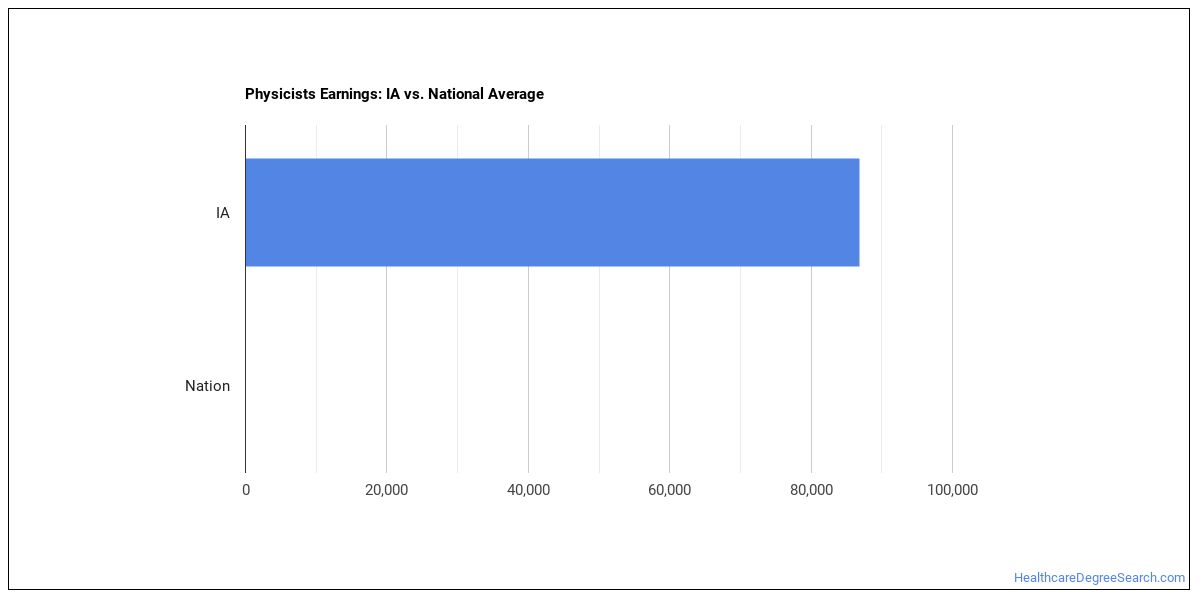
For physicists working in Iowa, the median annual wage is $120,810 per year (or about $58.08/hour).
| Wage Statistic | Annual | Hourly |
|---|---|---|
| 10th percentile | $62,500 | $30.05 |
| 25th percentile | $86,830 | $41.74 |
| Median (50th) | $120,810 | $58.08 |
| 75th percentile | $224,050 | $107.71 |
| 90th percentile | n/a | n/a |

The job concentration index in Iowa relative to the national average — is 0.55, suggesting fewer physicists per worker than the national average.
National Wage Comparison
Nationally, physicists earn a median of $111,776 per year ($53.74/hour), exceeding the Iowa median.
Employment Outlook
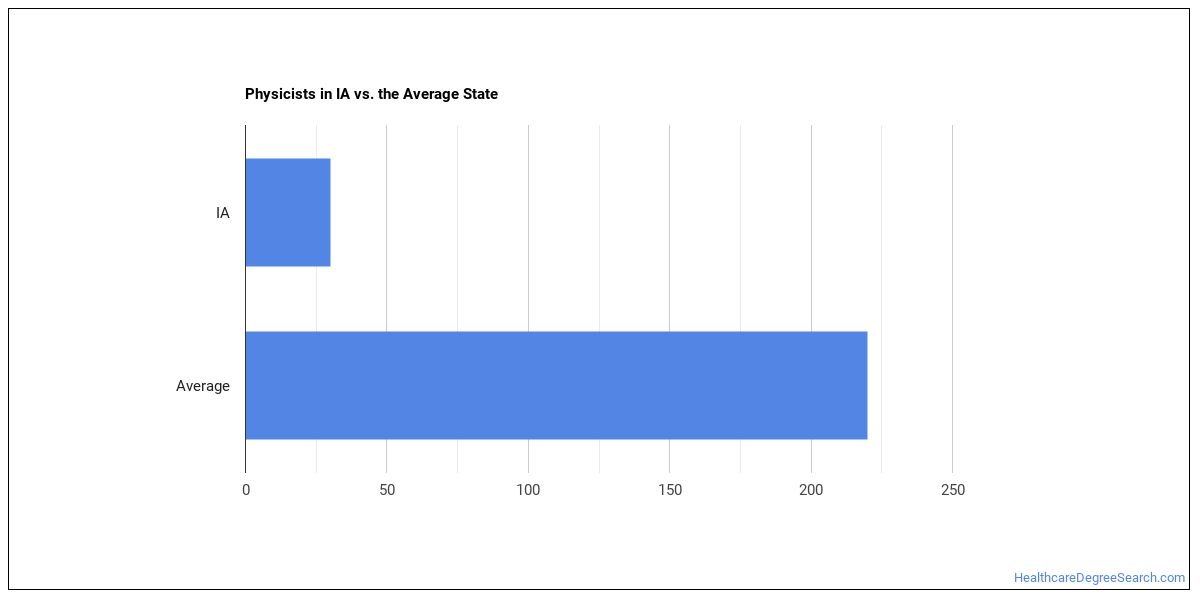
There are roughly 109,390 physicists in the U.S.. In Iowa alone, around 120 people work in this role. That’s below the typical state, which employs around 240 physicists.

Top States for Physicists Employment
These states have the highest employment of physicists work.
| State | Number Employed |
|---|---|
| California | 6,220 |
| Illinois | 1,660 |
| Maryland | 1,420 |
| Virginia | 1,260 |
| New York | 1,190 |
| Colorado | 1,120 |
| New Mexico | 770 |
| Ohio | 710 |
| Texas | 700 |
| District of Columbia | 570 |
| Massachusetts | 570 |
| Michigan | 550 |
| Pennsylvania | 540 |
| Washington | 430 |
| South Carolina | 370 |
| Alabama | 360 |
| New Jersey | 320 |
| Tennessee | 260 |
| Florida | 240 |
| Wisconsin | 220 |
Highest-Paying States for Physicists
Where physicists earn the most: physicists.
| State | Annual Median Salary |
|---|---|
| Minnesota | $222,550 |
| Florida | $209,020 |
| Pennsylvania | $208,470 |
| Arizona | $190,960 |
| Oregon | $183,860 |
| California | $180,900 |
| Missouri | $180,450 |
| New Hampshire | $179,440 |
| New Mexico | $175,960 |
| New York | $174,160 |
Skills
Key physicists skills, rated on an importance scale of 0 to 5:
Knowledge Areas
Important knowledge areas for this occupation, rated on an importance scale of 0 to 5:
Abilities
Key abilities for physicists, rated on an importance scale of 0 to 5:
Daily Tasks
Day-to-day, physicists typically:
- Perform complex calculations as part of the analysis and evaluation of data, using computers.
- Analyze data from research conducted to detect and measure physical phenomena.
- Describe and express observations and conclusions in mathematical terms.
- Design computer simulations to model physical data so that it can be better understood.
- Write research proposals to receive funding.
- Teach physics to students.
- Report experimental results by writing papers for scientific journals or by presenting information at scientific conferences.
- Observe the structure and properties of matter, and the transformation and propagation of energy, using equipment such as masers, lasers, and telescopes, to explore and identify the basic principles governing these phenomena.
- Develop theories and laws on the basis of observation and experiments, and apply these theories and laws to problems in areas such as nuclear energy, optics, and aerospace technology.
- Collaborate with other scientists in the design, development, and testing of experimental, industrial, or medical equipment, instrumentation, and procedures.
Work Activities
- Analyzing Data or Information
- Working with Computers
- Getting Information
- Processing Information
- Updating and Using Relevant Knowledge
- Making Decisions and Solving Problems
- Identifying Objects, Actions, and Events
- Documenting/Recording Information
- Thinking Creatively
- Communicating with Supervisors, Peers, or Subordinates
- Estimating the Quantifiable Characteristics of Products, Events, or Information
- Interpreting the Meaning of Information for Others
Tools & Technology
Common tools and software used in this occupation include: Hot technologies: Adobe Photoshop, Amazon Web Services AWS software, Ansible software, Autodesk AutoCAD In-demand technologies: Eclipse IDE
What Major Will Prepare You For This Career?
Programs that train for this career include:
- Public Health
Featured schools near , edit
Related Careers
Related occupations to physicists include:
- Computer and Information Research Scientists
- Mathematicians
- Statisticians
- Data Scientists
- Aerospace Engineers
- Bioengineers and Biomedical Engineers
Also Known As
Aerodynamicist, Aerophysicist, Astrophysicist, Atmospheric Physicist, Atomic Spectroscopist, Biophysics Scientist, Cloud Physicist, Computational Physicist, Condensed Matter Physicist, Diagnostic Medical Physicist, Electrodynamicist, Experimental Physicist, Fluid Dynamicist, Health Physicist, Mass Spectroscopist.
References
- U.S. Bureau of Labor Statistics, Occupational Employment and Wage Statistics — https://www.bls.gov/oes/
- O*NET Online — https://www.onetonline.org/
- BLS Employment Projections — https://www.bls.gov/emp/
- O*NET-SOC code: 19-2012.00

HealthcareDegreeSearch.com provides higher-education, college and university, degree, program, career, salary, and other helpful information to students, faculty, institutions, and other internet audiences. Presented information and data are subject to change. Inclusion on this website does not imply or represent a direct relationship with the company, school, or brand. Information, though believed correct at time of publication, may not be correct, and no warranty is provided. Contact the schools to verify any information before relying on it. Financial aid may be available for those who qualify. The displayed options may include sponsored or recommended results, not necessarily based on your preferences.
© HealthcareDegreeSearch.com – All Rights Reserved.