Epidemiologists in Connecticut
Considering working as an Epidemiologists in Connecticut? Here’s what you need to know. Investigate and describe the determinants and distribution of disease, disability, or health outcomes. May develop the means for prevention and control.
What do Epidemiologists Make in Connecticut?
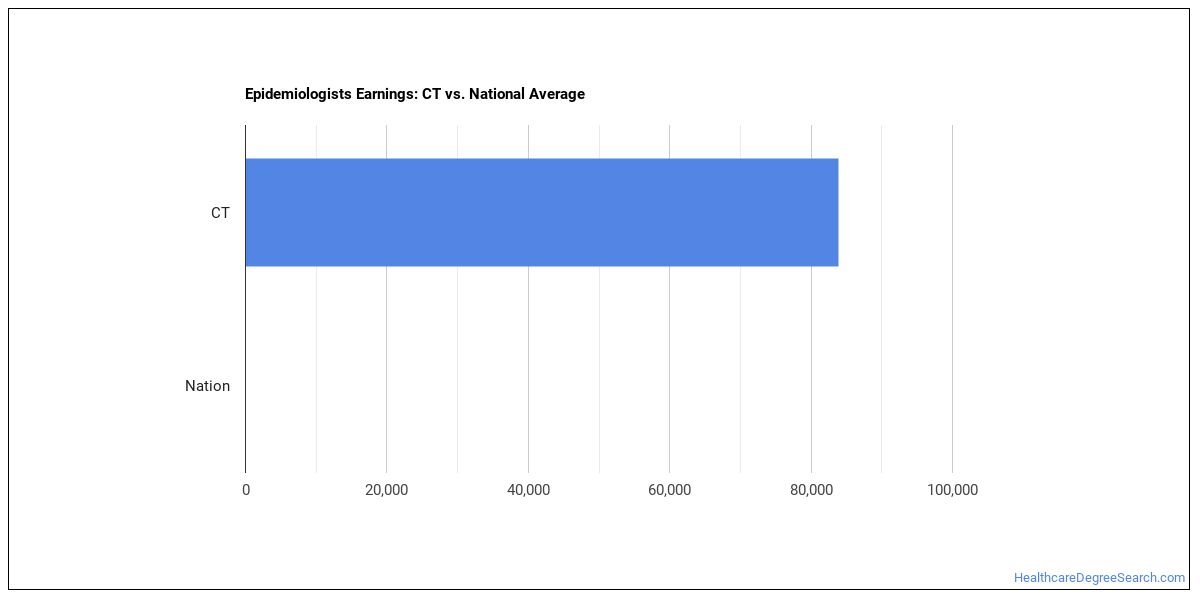
For a epidemiologists working in Connecticut, wages run about $85,190 per year (or about $40.96/hour).Earnings range from $61,250 at the 10th percentile to $114,300 at the 90th percentile.
| Wage Statistic | Annual | Hourly |
|---|---|---|
| 10th percentile | $61,250 | $29.45 |
| 25th percentile | $72,510 | $34.86 |
| Median (50th) | $85,190 | $40.96 |
| 75th percentile | $99,830 | $48.00 |
| 90th percentile | $114,300 | $54.95 |

Location quotient — how concentrated this career is in Connecticut relative to the national average — is 1.26, meaning that epidemiologists are more concentrated here than the national average.
National Wage Comparison
Nationally, epidemiologists earn a median of $87,636 per year ($42.13/hour), lower than the Connecticut median.
Employment Outlook
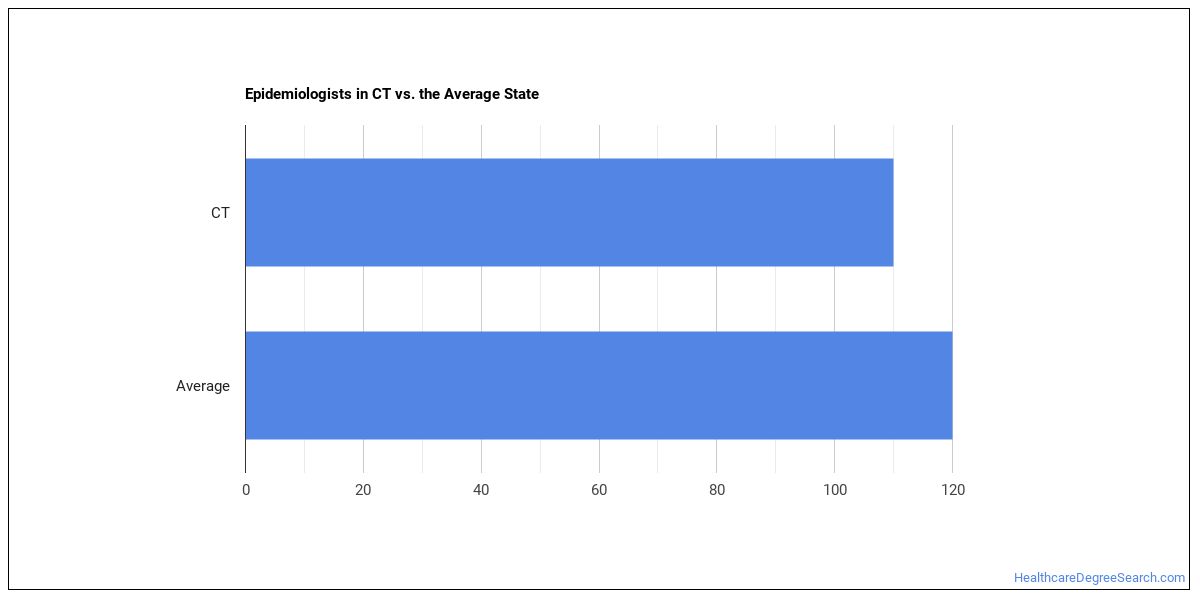
National employment for 184,821 epidemiologists across the United States. In Connecticut alone, about 160 people work in this role. That’s right around the typical state median of 160.

Top Connecticut Metros for Epidemiologists
These are the Connecticut metros with the most epidemiologists in Connecticut.
| Metro Area | Number Employed | Annual Median Salary |
|---|---|---|
| Hartford-West Hartford-East Hartford, CT | 140 | $86,120 |
Top States for Epidemiologists Employment
The table below shows the states where the most epidemiologists work.
| State | Number Employed |
|---|---|
| California | 1,590 |
| Washington | 960 |
| Texas | 940 |
| Colorado | 620 |
| Georgia | 610 |
| Massachusetts | 470 |
| New York | 460 |
| Maryland | 440 |
| Pennsylvania | 400 |
| Florida | 330 |
| Arizona | 290 |
| Ohio | 270 |
| Michigan | 260 |
| Minnesota | 260 |
| Tennessee | 240 |
| Virginia | 240 |
| Illinois | 190 |
| Utah | 180 |
| North Carolina | 180 |
| Connecticut | 160 |
Highest-Paying States for Epidemiologists
Where epidemiologists earn the most: epidemiologists.
| State | Annual Median Salary |
|---|---|
| New Jersey | $110,240 |
| Massachusetts | $104,920 |
| Rhode Island | $100,820 |
| California | $100,410 |
| Washington | $99,930 |
| Minnesota | $99,360 |
| Illinois | $99,220 |
| District of Columbia | $98,340 |
| Tennessee | $96,910 |
| Maryland | $94,460 |
Skills
The most important epidemiologists skills, rated on an importance scale of 0 to 5:
Knowledge Areas
Key knowledge areas for this occupation, rated on an importance scale of 0 to 5:
Abilities
Key abilities for epidemiologists, rated on an importance scale of 0 to 5:
Daily Tasks
Epidemiologists typically:
- Communicate research findings on various types of diseases to health practitioners, policy makers, and the public.
- Oversee public health programs, including statistical analysis, health care planning, surveillance systems, and public health improvement.
- Investigate diseases or parasites to determine cause and risk factors, progress, life cycle, or mode of transmission.
- Educate healthcare workers, patients, and the public about infectious and communicable diseases, including disease transmission and prevention.
- Monitor and report incidents of infectious diseases to local and state health agencies.
- Plan and direct studies to investigate human or animal disease, preventive methods, and treatments for disease.
- Provide expertise in the design, management and evaluation of study protocols and health status questionnaires, sample selection, and analysis.
- Write articles for publication in professional journals.
- Identify and analyze public health issues related to foodborne parasitic diseases and their impact on public policies, scientific studies, or surveys.
- Write grant applications to fund epidemiologic research.
- Plan, administer and evaluate health safety standards and programs to improve public health, conferring with health department, industry personnel, physicians, and others.
- Conduct research to develop methodologies, instrumentation, and procedures for medical application, analyzing data and presenting findings.
Work Activities
- Analyzing Data or Information
- Making Decisions and Solving Problems
- Working with Computers
- Interpreting the Meaning of Information for Others
- Processing Information
- Updating and Using Relevant Knowledge
- Getting Information
- Communicating with People Outside the Organization
- Communicating with Supervisors, Peers, or Subordinates
- Thinking Creatively
- Documenting/Recording Information
- Identifying Objects, Actions, and Events
Tools & Technology
Technologies frequently used: Hot technologies: ESRI ArcGIS software, Facebook In-demand technologies: Microsoft Excel
What Major Will Prepare You For This Career?
Related college programs include:
- Public Health
- Medical Science
Featured schools near , edit
Related Careers
Related occupations to epidemiologists include:
- Clinical Research Coordinators
- Health Informatics Specialists
- Microbiologists
- Geneticists
- Medical Scientists, Except Epidemiologists
- Neuropsychologists
Also Known As
Chronic Disease Epidemiologist, Clinical Epidemiologist, Clinical Lab Scientist (Clinical Laboratory Scientist), Clinical Researcher, Communicable Diseases Specialist, Environmental Epidemiologist, Epidemiologist, Epidemiologist Researcher, Epidemiology Analyst, Epidemiology Investigator, Epidemiology Research Doctor, Histopathologist, Infection Control Coordinator, Infection Control Manager, Infection Control Nurse (ICN).
References
- U.S. Bureau of Labor Statistics, Occupational Employment and Wage Statistics — https://www.bls.gov/oes/
- O*NET Online — https://www.onetonline.org/
- BLS Employment Projections — https://www.bls.gov/emp/
- O*NET-SOC code: 19-1041.00

HealthcareDegreeSearch.com provides higher-education, college and university, degree, program, career, salary, and other helpful information to students, faculty, institutions, and other internet audiences. Presented information and data are subject to change. Inclusion on this website does not imply or represent a direct relationship with the company, school, or brand. Information, though believed correct at time of publication, may not be correct, and no warranty is provided. Contact the schools to verify any information before relying on it. Financial aid may be available for those who qualify. The displayed options may include sponsored or recommended results, not necessarily based on your preferences.
© HealthcareDegreeSearch.com – All Rights Reserved.