Nurse Anesthetists in Iowa
Considering working as a Nurse Anesthetists in Iowa? Here’s what you need to know. Administer anesthesia, monitor patient’s vital signs, and oversee patient recovery from anesthesia. May assist anesthesiologists, surgeons, other physicians, or dentists. Must be registered nurses who have specialized graduate education.
What do Nurse Anesthetists Make in Iowa?
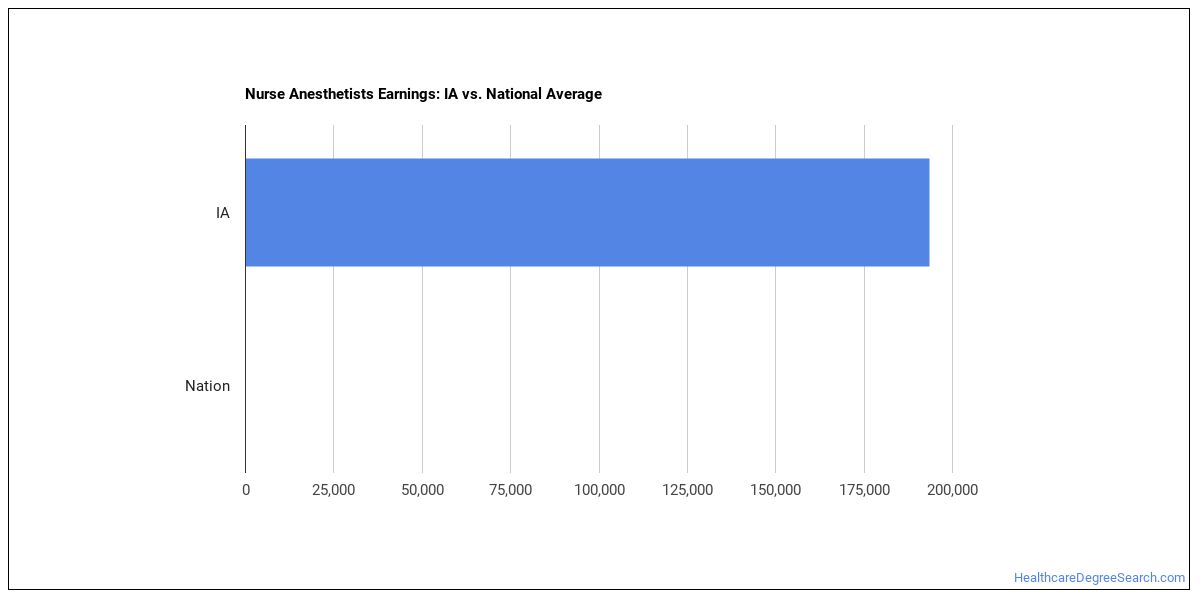
For a nurse anesthetists working in Iowa, the typical annual salary is $229,950 per year (or about $110.56/hour).
| Wage Statistic | Annual | Hourly |
|---|---|---|
| 10th percentile | $204,630 | $98.38 |
| 25th percentile | $218,050 | $104.83 |
| Median (50th) | $229,950 | $110.56 |
| 75th percentile | n/a | n/a |
| 90th percentile | n/a | n/a |

The location quotient — a measure of how concentrated this occupation is in Iowa relative to the national average — is 1.13, meaning that nurse anesthetists are more concentrated here than the national average.
National Wage Comparison
Nationally, nurse anesthetists earn a median of $66,747 per year ($32.09/hour), exceeding the Iowa median.
Employment Outlook
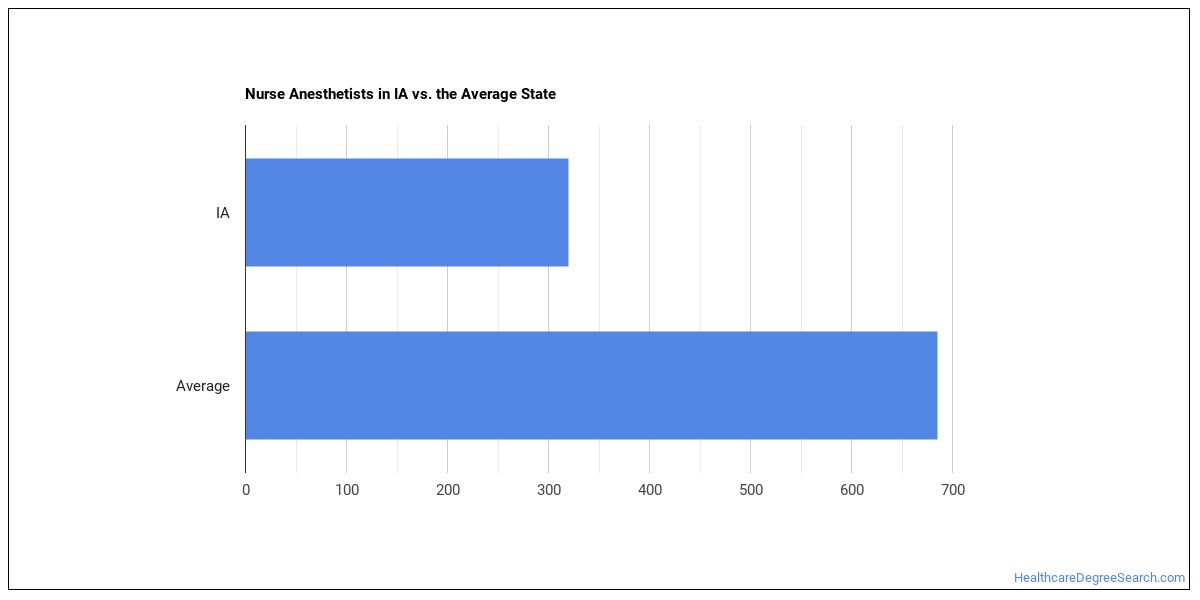
There are roughly 3,489,995 nurse anesthetists nationwide. In Iowa alone, about 580 people work in this role. That trails the typical state, which employs around 790 nurse anesthetists.

Top Iowa Metros for Nurse Anesthetists
The metro areas below employ the most nurse anesthetists in Iowa.
| Metro Area | Number Employed | Annual Median Salary |
|---|---|---|
| Des Moines-West Des Moines, IA | 150 | $232,960 |
| Waterloo-Cedar Falls, IA | 40 | $221,110 |
Top States for Nurse Anesthetists Employment
View the states that employ the most nurse anesthetists work.
| State | Number Employed |
|---|---|
| Florida | 6,140 |
| Texas | 3,660 |
| Michigan | 2,960 |
| North Carolina | 2,820 |
| Pennsylvania | 2,660 |
| Minnesota | 2,570 |
| Ohio | 2,460 |
| Tennessee | 2,360 |
| California | 2,270 |
| Alabama | 1,410 |
| New Jersey | 1,320 |
| Illinois | 1,270 |
| New York | 1,210 |
| Missouri | 1,210 |
| Georgia | 1,160 |
| Kentucky | 1,050 |
| Wisconsin | 1,040 |
| Virginia | 980 |
| South Carolina | 950 |
| Louisiana | 890 |
Highest-Paying States for Nurse Anesthetists
These states pay the most for nurse anesthetists.
| State | Annual Median Salary |
|---|---|
| Delaware | $236,800 |
| Michigan | $234,520 |
| Indiana | $233,200 |
| North Dakota | $232,420 |
| Nebraska | $231,020 |
| Iowa | $229,950 |
| Maine | $229,900 |
| Arizona | $228,690 |
| Connecticut | $227,930 |
| Texas | $227,580 |
Skills
Top nurse anesthetists skills, rated on an importance scale of 0 to 5:
Knowledge Areas
Important knowledge areas for this occupation, rated on an importance scale of 0 to 5:
Abilities
Top abilities for nurse anesthetists, rated on an importance scale of 0 to 5:
Daily Tasks
Day-to-day, nurse anesthetists typically:
- Manage patients' airway or pulmonary status, using techniques such as endotracheal intubation, mechanical ventilation, pharmacological support, respiratory therapy, and extubation.
- Respond to emergency situations by providing airway management, administering emergency fluids or drugs, or using basic or advanced cardiac life support techniques.
- Monitor patients' responses, including skin color, pupil dilation, pulse, heart rate, blood pressure, respiration, ventilation, or urine output, using invasive and noninvasive techniques.
- Select, order, or administer anesthetics, adjuvant drugs, accessory drugs, fluids or blood products as necessary.
- Select, prepare, or use equipment, monitors, supplies, or drugs for the administration of anesthetics.
- Assess patients' medical histories to predict anesthesia response.
- Perform or manage regional anesthetic techniques, such as local, spinal, epidural, caudal, nerve blocks and intravenous blocks.
- Develop anesthesia care plans.
- Obtain informed consent from patients for anesthesia procedures.
- Prepare prescribed solutions and administer local, intravenous, spinal, or other anesthetics, following specified methods and procedures.
- Perform pre-anesthetic screenings, including physical evaluations and patient interviews, and document results.
- Calibrate and test anesthesia equipment.
Work Activities
- Assisting and Caring for Others
- Getting Information
- Documenting/Recording Information
- Updating and Using Relevant Knowledge
- Making Decisions and Solving Problems
- Identifying Objects, Actions, and Events
- Analyzing Data or Information
- Inspecting Equipment, Structures, or Materials
- Communicating with Supervisors, Peers, or Subordinates
- Monitoring Processes, Materials, or Surroundings
- Evaluating Information to Determine Compliance with Standards
- Processing Information
Tools & Technology
Technologies frequently used: Hot technologies: eClinicalWorks EHR software In-demand technologies: Epic Systems
What Major Will Prepare You For This Career?
Programs that train for this career include:
Related Careers
Related occupations to nurse anesthetists include:
- Physician Assistants
- Anesthesiologist Assistants
- Respiratory Therapists
- Registered Nurses
- Acute Care Nurses
- Critical Care Nurses
Also Known As
Anesthesia Physician, Anesthesia Specialist, Certified Nurse Anesthetist, Certified Registered Nurse Anesthetist (CRNA), Nurse Anesthetist, Staff Certified Registered Nurse Anesthetist (Staff CRNA), Staff Nurse Anesthetist.
References
- U.S. Bureau of Labor Statistics, Occupational Employment and Wage Statistics — https://www.bls.gov/oes/
- O*NET Online — https://www.onetonline.org/
- BLS Employment Projections — https://www.bls.gov/emp/
- O*NET-SOC code: 29-1151.00

HealthcareDegreeSearch.com provides higher-education, college and university, degree, program, career, salary, and other helpful information to students, faculty, institutions, and other internet audiences. Presented information and data are subject to change. Inclusion on this website does not imply or represent a direct relationship with the company, school, or brand. Information, though believed correct at time of publication, may not be correct, and no warranty is provided. Contact the schools to verify any information before relying on it. Financial aid may be available for those who qualify. The displayed options may include sponsored or recommended results, not necessarily based on your preferences.
© HealthcareDegreeSearch.com – All Rights Reserved.