Psychiatrists in New York
Thinking about a career as a Psychiatrists in New York? Below are the key facts. Diagnose, treat, and help prevent mental disorders. Excludes “Clinical and Counseling Psychologists” (19-3033) and “School Psychologists” (19-3034).
What do Psychiatrists Make in New York?
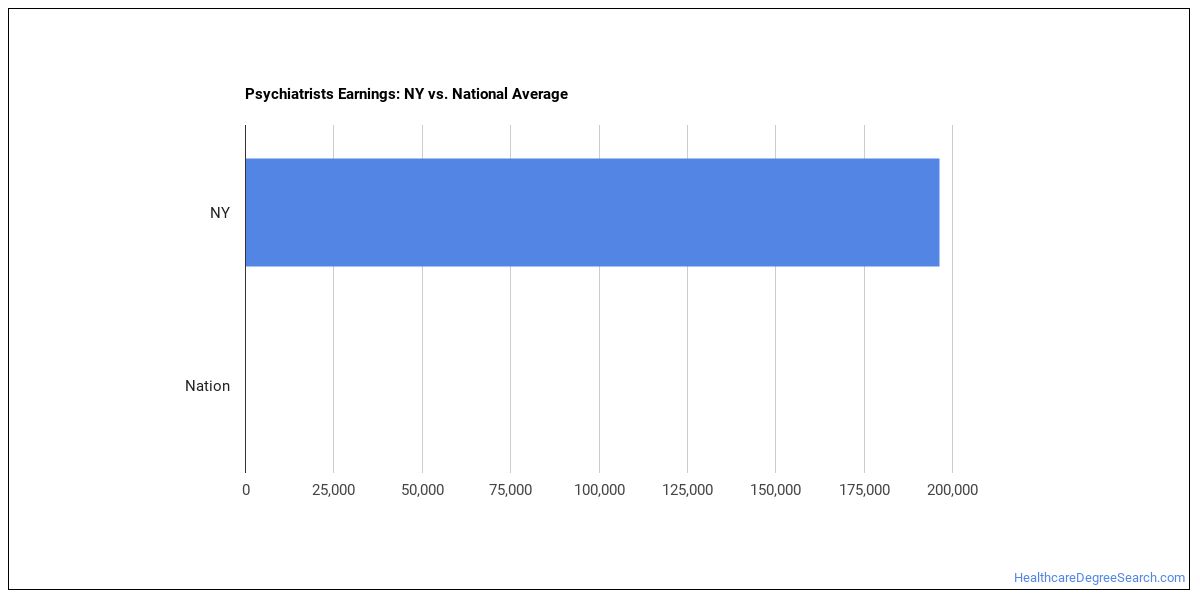
The psychiatrists working in New York, wages run about $228,580 per year (or about $109.90/hour).
| Wage Statistic | Annual | Hourly |
|---|---|---|
| 10th percentile | $83,200 | $40.00 |
| 25th percentile | $97,540 | $46.89 |
| Median (50th) | $228,580 | $109.90 |
| 75th percentile | n/a | n/a |
| 90th percentile | n/a | n/a |

The location quotient — a measure of how concentrated this occupation is in New York relative to the national average — is 2.51, meaning that psychiatrists are more concentrated here than the national average.
National Wage Comparison
Nationally, psychiatrists earn a median of $41,130 per year ($19.77/hour), higher than the New York median.
Employment Outlook
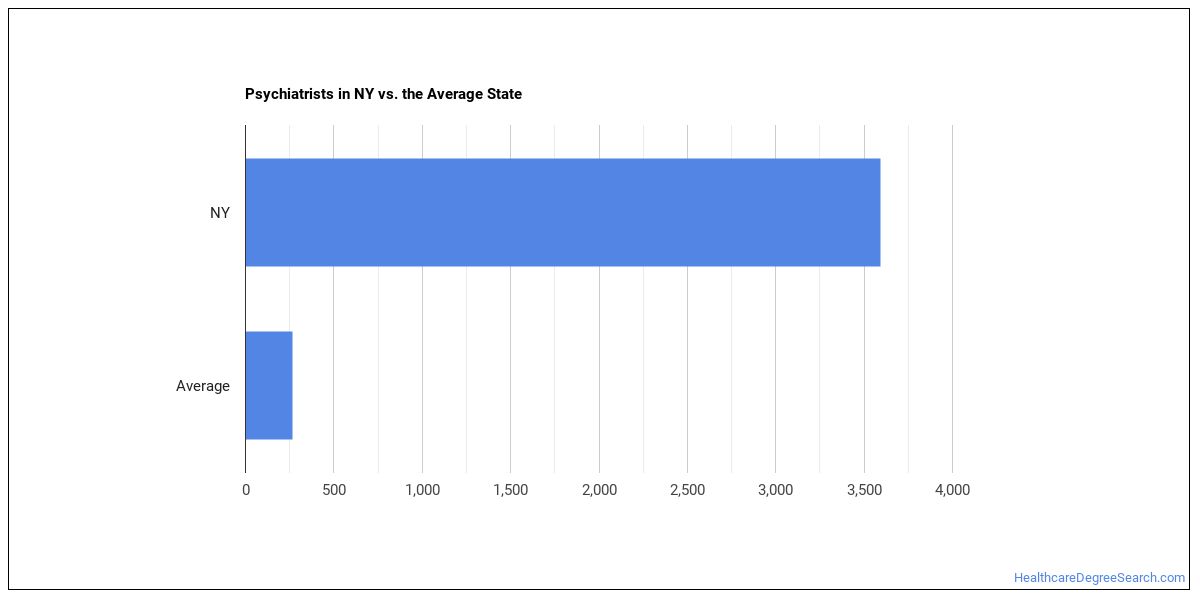
Nationally, total employment in this occupation is 1,741,236 psychiatrists across the United States. In New York alone, approximately 3,850 people work in this role. That’s higher than the typical state, which employs around 300 psychiatrists.

Top New York Metros for Psychiatrists
The largest metro-area employers of psychiatrists in New York.
| Metro Area | Number Employed | Annual Median Salary |
|---|---|---|
| New York-Newark-Jersey City, NY-NJ | 3,680 | $229,630 |
| Rochester, NY | 130 | $182,270 |
| Albany-Schenectady-Troy, NY | 120 | $219,910 |
| Buffalo-Cheektowaga, NY | 80 | $224,260 |
| Kiryas Joel-Poughkeepsie-Newburgh, NY | 80 | n/a |
| Utica-Rome, NY | 50 | n/a |
| Syracuse, NY | 30 | $226,560 |
Top States for Psychiatrists Employment
The table below shows the states where the most psychiatrists work.
| State | Number Employed |
|---|---|
| California | 4,350 |
| New York | 3,850 |
| Florida | 1,630 |
| Massachusetts | 1,210 |
| Texas | 1,030 |
| New Jersey | 890 |
| Pennsylvania | 850 |
| Ohio | 720 |
| Illinois | 650 |
| Maryland | 620 |
| Minnesota | 610 |
| Wisconsin | 570 |
| Michigan | 520 |
| Georgia | 460 |
| Arizona | 450 |
| Connecticut | 430 |
| Washington | 420 |
| Indiana | 390 |
| Virginia | 390 |
| Oregon | 360 |
Highest-Paying States for Psychiatrists
The highest-paying states for psychiatrists.
| State | Annual Median Salary |
|---|---|
| Delaware | $236,740 |
| Kentucky | $229,630 |
| Nebraska | $229,240 |
| Georgia | $229,190 |
| New York | $228,580 |
| Massachusetts | $221,160 |
| New Hampshire | $211,370 |
| Hawaii | $203,440 |
| Nevada | $202,860 |
| Arkansas | $195,430 |
Skills
Key psychiatrists skills, rated on an importance scale of 0 to 5:
Knowledge Areas
Core knowledge areas for this occupation, rated on an importance scale of 0 to 5:
Abilities
Key abilities for psychiatrists, rated on an importance scale of 0 to 5:
Daily Tasks
Day-to-day, psychiatrists typically:
- Prescribe, direct, or administer psychotherapeutic treatments or medications to treat mental, emotional, or behavioral disorders.
- Gather and maintain patient information and records, including social or medical history obtained from patients, relatives, or other professionals.
- Design individualized care plans, using a variety of treatments.
- Collaborate with physicians, psychologists, social workers, psychiatric nurses, or other professionals to discuss treatment plans and progress.
- Analyze and evaluate patient data or test findings to diagnose nature or extent of mental disorder.
- Examine or conduct laboratory or diagnostic tests on patients to provide information on general physical condition or mental disorder.
- Counsel outpatients or other patients during office visits.
- Advise or inform guardians, relatives, or significant others of patients' conditions or treatment.
- Teach, take continuing education classes, attend conferences or seminars, or conduct research and publish findings to increase understanding of mental, emotional, or behavioral states or disorders.
- Review and evaluate treatment procedures and outcomes of other psychiatrists or medical professionals.
- Prepare and submit case reports or summaries to government or mental health agencies.
- Serve on committees to promote or maintain community mental health services or delivery systems.
Work Activities
- Assisting and Caring for Others
- Getting Information
- Making Decisions and Solving Problems
- Establishing and Maintaining Interpersonal Relationships
- Updating and Using Relevant Knowledge
- Documenting/Recording Information
- Communicating with Supervisors, Peers, or Subordinates
- Identifying Objects, Actions, and Events
- Training and Teaching Others
- Interpreting the Meaning of Information for Others
- Providing Consultation and Advice to Others
- Analyzing Data or Information
Tools & Technology
Technologies frequently used: Hot technologies: eClinicalWorks EHR software
What Major Will Prepare You For This Career?
Several college majors map to this occupation:
Related Careers
Other careers like psychiatrists include:
- Clinical and Counseling Psychologists
- Neuropsychologists
- Clinical Neuropsychologists
- Acute Care Nurses
- Advanced Practice Psychiatric Nurses
- Clinical Nurse Specialists
Also Known As
Addiction Psychiatrist, Adult Inpatient Psychiatrist, Adult Outpatient Psychiatrist, Adult Psychiatrist, Behavioral Analyst, Behavioral Specialist, Child Psychiatrist, Child and Adolescent Psychiatry Physician, Clinical Psychiatrist, Consulting Psychiatrist, DO Physician (Doctor of Osteopathic Medicine Physician), Doctor, General Adult Psychiatrist, General Psychiatrist, Inpatient Psychiatrist.
References
- U.S. Bureau of Labor Statistics, Occupational Employment and Wage Statistics — https://www.bls.gov/oes/
- O*NET Online — https://www.onetonline.org/
- BLS Employment Projections — https://www.bls.gov/emp/
- O*NET-SOC code: 29-1223.00

HealthcareDegreeSearch.com provides higher-education, college and university, degree, program, career, salary, and other helpful information to students, faculty, institutions, and other internet audiences. Presented information and data are subject to change. Inclusion on this website does not imply or represent a direct relationship with the company, school, or brand. Information, though believed correct at time of publication, may not be correct, and no warranty is provided. Contact the schools to verify any information before relying on it. Financial aid may be available for those who qualify. The displayed options may include sponsored or recommended results, not necessarily based on your preferences.
© HealthcareDegreeSearch.com – All Rights Reserved.